|
|
|
The
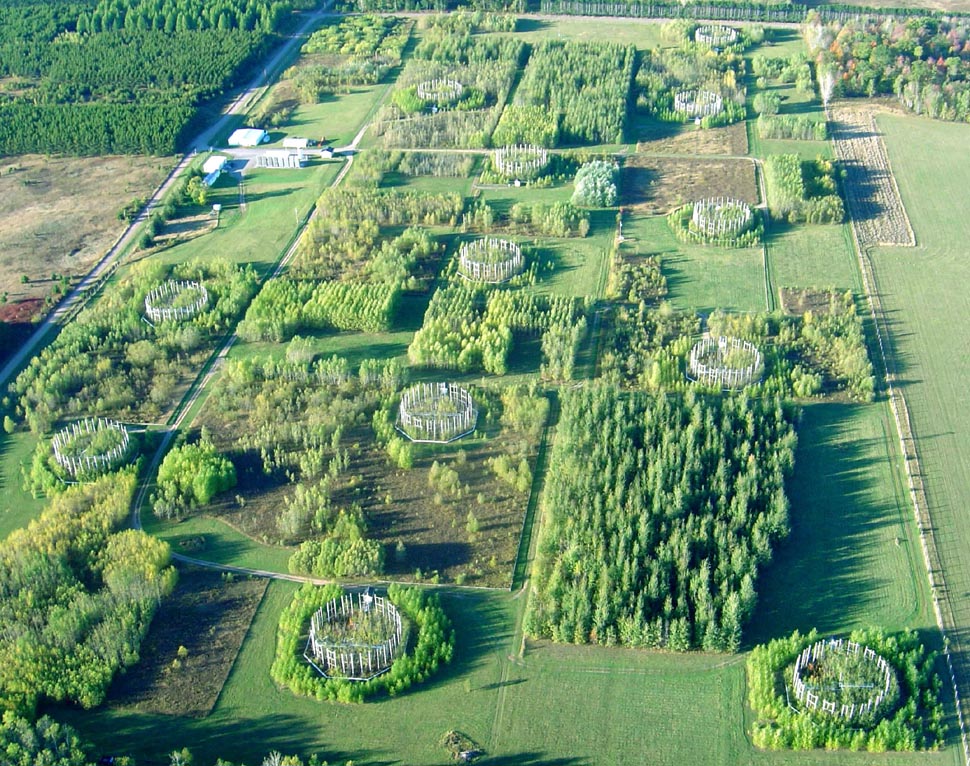
Aspen FACE (Free-Air Carbon Dioxide Enrichment) Experiment is a multidisciplinary
study to
assess the effects of increasing tropospheric ozone and carbon dioxide
levels on the structure and function of northern forest ecosystems.
Aspen
FACE continued in 2010 as the Northern Forest Ecosystem
Experiment (NFEE), funded by the US Forest Service. Original trees were
harvested during 2009 and a new forest vigorously sprouted under the
FACE treatments in 2010 before treatments were discontinued. Researchers
interested in data or samples from FACE and NFEE should fill out a research
registration form using the link above.
| |
Located
at the Harshaw Experimental Forest near Rhinelander, Wisconsin, the
Aspen FACE Experiment operates as a DOE User Facility,
and is a collaborative effort among the following organizations:
|
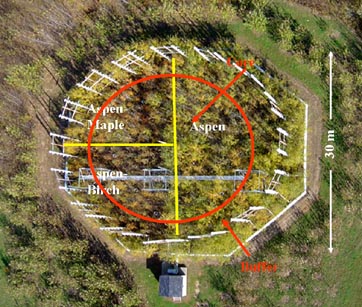
Distribution
of species within ring.
|
|

|
|
|
The
Aspen FACE experiment consists of twelve 30m rings in which the concentrations
of carbon dioxide and tropospheric ozone can be controlled. The design
provides the ability to assess the effects of these gasses alone, and
in combination, on many ecosystem attributes, including growth, leaf
development, root characteristics, and soil carbon. |
|
|
|
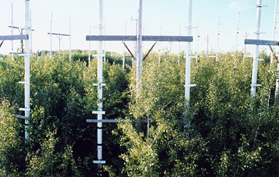
Each
ring consists of a series of vertical ventpipes which disperse carbon
dioxide, ozone or normal air into the center of the ring. This computer
controlled system uses signal feedback technology to adjust gas release
each second in order to maintain a stable, elevated concentration
of carbon dioxide and/or ozone throughout the experimental plot. Because
there is no confinement, there is no significant change in the natural,
ambient environment other than elevating these trace gas concentrations.
|
|
The following is a list of
recent accomplishments for the project.
Notices on events, meetings,
publications, and new links are published here.
Visit
other FACE, global change, and modeling web sites here:
AspenFACE
Meteorological Data
Duke
University FACE site
The FACE Program at
Brookhaven National Labratory
AspenFACE Micromet
Tower Data
FACE
for Agronomic Crops - Maricopa, Arizona
BIOCON
- The University of Minnesota Grassland FACE site
The Northern
Forest Ecosystem Experiment (NFEE) is funded by the US Forest Service. The
Aspen FACE Experiment is funded principally by the U.S. Department
of Energy's Office of Biological and Environmental Research. Additional
support is from the USFS Global Change Program, Michigan Technological University,
the Canadian Forest Service and the USFS Northern Research Station.
For
more information on this project, contact Dr. Andrew J. Burton (Michigan
Technological University) at (906) 487-2566 or mailto:ajburton@mtu.edu,
or Dr. Mark E. Kubiske (Northern Research Station) at (715) 362-1108 or
mailto:mkubiske@fs.fed.us.
For
questions or suggestions regarding this website, please contact Wendy Jones
at mailto:wsjones@mtu.edu.
Last updated: MAY, 2012
|